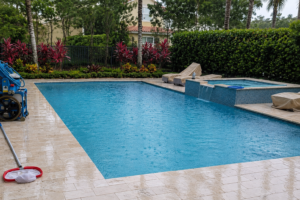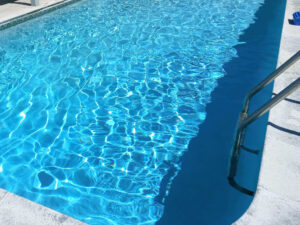
Florida summers are generous. Generous with heat, generous with humidity, and several times a week, generous with rain. Your pool gets all of it, every single day.
And your chlorine? It’s fighting for its life.
Chlorine is the only thing standing between your pool water and the bacteria, algae, and organic debris that want to live in it. When chlorine levels drop, that protection disappears, and faster than most people expect. A pool that tested fine on Monday can have genuinely unsafe water by the weekend.
What’s actually happening is that summer puts more pressure on your pool’s chemistry. Heat, UV, rain, and heavy use all consume chlorine faster than normal, and in South Florida, all of it arrives at once. This article explains why your pool loses chlorine fast in summer, and what you can do to stay ahead of it.
What Causes a Pool to Lose Chlorine Faster in Summer?
Chlorine is a hardworking chemical, but it has limits. It sanitizes your pool by reacting with contaminants like bacteria, algae, organic debris, and whatever your swimmers bring in with them. Every reaction uses some up. In summer, everything that consumes chlorine increases at once.
Water temperatures rise, the number of swimmers increases, storms roll through, and UV exposure intensifies. Each of these factors alone would raise your chlorine demand. Together, they can drain a well-treated pool in a matter of days.
South Florida pools get used year-round, which already makes maintenance more demanding than pools in colder climates. Summer dials that pressure up further. The chlorine dosage that worked for your pool in February won’t be enough in July.
Impact of UV and Sunlight on Pool Chlorine
Florida sunshine is glorious, unless you’re chlorine. The same sun that makes your pool feel like a luxury is quietly working against it.
Ultraviolet light breaks down free chlorine, the active form that’s actually doing the sanitizing work, and this breakdown happens fast. An uncovered outdoor pool exposed to direct summer sun can lose up to 90% of its chlorine within a couple of hours with no protection in place.
The fix is a chemical called cyanuric acid, often called a stabilizer or conditioner. It works like sunscreen for your pool’s chlorine, slowing UV degradation so chlorine lasts longer. Most outdoor pools should maintain stabilizer levels between 30 and 50 parts per million (ppm).
If stabilizer is too low, chlorine burns off quickly. If stabilizer becomes too high, chlorine becomes less effective and additional chlorine may not provide the expected results. Proper testing helps determine whether stabilizer levels need to be adjusted.
Getting stabilizer into the right range is one of the most impactful adjustments a South Florida pool owner can make heading into summer.
How Hot Weather Makes Your Pool Lose Chlorine Fast
Heat speeds up chemical reactions, which sounds useful until you realize that includes the reactions consuming your chlorine. Higher temperatures also encourage algae and bacteria growth, so chlorine has to work harder to keep up, and levels drop faster than expected.
String together a few consecutive hot days, typical of a Florida summer, and chlorine demand rises noticeably. Check your pool after a hot weekend and you’ll almost always find lower chlorine than you expect.
That’s why a pool that tested fine on a cool April evening can look questionable after a hot July weekend.
Rain and Storms Dilute Pool Chlorine
If you live in Palm Beach County, you know the drill. Most summer afternoons bring a thunderstorm with them, sometimes dropping half an inch of rain, sometimes far more.
Rain itself doesn’t instantly remove chlorine, but heavy rainfall dilutes pool water and shifts overall water chemistry. Storms also bring in leaves, dirt, pollen, and debris, and every bit of organic material that lands in the water gives chlorine more work to do.
Storm runoff also tends to introduce phosphates, which are an algae favorite. More runoff means more phosphates, which means more algae growth. That’s why a pool can look fine one afternoon and noticeably off the next morning after a storm rolls through.
During our summer service visits, it’s common to see chlorine levels noticeably lower the day after a heavy afternoon thunderstorm, especially when the pool has collected leaves and other organic debris.
Chlorine demand climbs fast once the rain starts.
More from Finn’s Pool Services’ Blog
If you want to learn more about the relationship between rain and pool chemistry, read our article on why pool water turns cloudy after heavy rain.
Heavy Pool Use and Organic Contaminants
It’s the season of pools. Kids are home from school, friends come over for barbecues, family visits, and everyone wants to cool off.
Every swimmer brings contaminants into the water. Sweat, sunscreen, body oils, cosmetics, and small amounts of organic material all consume chlorine, which is why levels often drop sharply after a busy weekend.
A new customer called us over to take a look at their pool after the 4th of July weekend. Their chlorine wasn’t holding, and they’d noticed the floor getting slippery. They’d just had their pool pump replaced and were worried that the new equipment had malfunctioned.
When we got there, we found out they’d had a family reunion, around 12 people using the pool repeatedly over the weekend, spending most afternoons in the water with sunscreen reapplied every few hours. We knew right away the chlorine and stabilizer needed to be refilled and rebalanced. As a precaution, we also ran a full equipment check, and everything else was running fine. The pool wasn’t malfunctioning. It just had a much bigger workload than usual that weekend.
How to Maintain Proper Chlorine Levels in Summer
None of this is a reason to worry. It just means your pool needs more attention during summer than the rest of the year. Here’s what that looks like in practice:
- Test for chlorine twice a week instead of weekly. Conditions change fast during summer.
- Keep pH between 7.4 and 7.6. Chlorine is significantly less effective outside this range, and high pH is another common cause of chlorine lock.
- Check stabilizer levels at the start of summer and adjust as needed.
- Run your pump longer in summer months. Water needs to circulate fully for chemicals to distribute evenly.
- Skim and brush regularly. Less organic debris in the water means less demand on your chlorine.
- Clean or backwash filters on schedule. A dirty filter reduces circulation and lets contaminants build up.
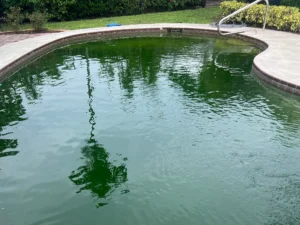
- Address algae growth the moment you spot a green tint or feel the floor getting slippery.
If keeping up with this kind of twice-weekly attention isn’t realistic with everything else going on, that’s exactly what our weekly pool cleaning service is built to handle.
Can Chlorine Loss Signal a Bigger Problem?
There’s a real difference between chlorine dropping faster in summer and chlorine disappearing immediately after you add it.
Seasonal chlorine depletion is normal and expected. Rapid chlorine loss that doesn’t respond to normal treatment is a different story, and can point to deeper issues like early algae growth, excessive phosphates, poor circulation, a serious chemistry imbalance, or several of these compounding together.
According to the U.S. Centers for Disease Control and Prevention (CDC), proper chlorine levels are one of the most critical factors in preventing recreational water illnesses. When chlorine keeps disappearing despite repeated treatment, the pool can become a real health hazard.
If you’ve shocked the pool twice in a week and levels still won’t hold, it’s time for professional water testing, not another trip to the pool supply store.
How Does Professional Maintenance Help During Summer?
The goal of regular pool maintenance is staying a step ahead of summer’s pool problems before they show up.
A consistent weekly service that includes proper testing, chemical balancing, brushing, skimming, filter checks, and equipment inspection catches small issues before they compound. An algae bloom caught early is a minor chemical adjustment. Caught late, it’s a multi-day, expensive remediation job.
Finn’s weekly maintenance service is built around exactly this kind of seasonal pressure. The goal is a pool that’s ready when you want to use it, not one you’re treating on a Saturday morning because a family reunion is starting that afternoon.
Summer Means Your Pool Needs More Chlorine Attention
If your pool loses chlorine fast during summer, it’s usually normal. Florida heat, UV exposure, afternoon storms, and heavier swimmer loads all increase how hard your sanitizer has to work. A pool losing chlorine fast in July isn’t a sign of poor maintenance. It’s usually a sign that the season has changed and your maintenance routine needs to change with it.
What isn’t normal is chlorine that won’t hold no matter what you do. If that’s where you are, don’t keep adding chemicals and hoping it resolves itself. Get the water tested properly, look at the full picture, and address what’s actually causing it.
Summer should be the season you use your pool the most, not the season you spend the most time worrying about it.
If you’re having trouble keeping chlorine levels stable or your pool chemistry balanced during the hottest months of the year, Finn’s Pool Services is here to help.
Photo: Mike Szczepanski / Unsplash
- Phone: (561) 566-9344
- Email: [email protected]
-
Address: 1335 Old Okeechobee Rd. #450
West Palm Beach, FL 33401 - Mon – Fri: 8:00 AM – 6:00 PM
- Sat & Sun: 9:30 AM – 4:00 PM