If you are trying to improve pool heater efficiency, one of the most common questions is whether the pool heats faster with the pump on or off.
The short answer is simple:
Your pool will not heat properly without the pump running.
All modern pool heaters, including gas heaters and heat pumps, require water flow to transfer heat. Without circulation, there is no heat exchange, and in most cases the heater will not even turn on.
Understanding how water flow impacts heating helps you avoid wasted energy and unnecessary equipment strain. If your heater is running but your pool still is not reaching the set temperature, the issue may involve circulation restrictions, sensors, or internal components that require professional pool repair diagnostics.
Table of Contents
How Water Flow Impacts Heating
Pool heaters do not heat water sitting in the pool. They heat water as it passes through the heater. Proper circulation is one of the biggest factors affecting overall pool heater efficiency.
Here’s what happens:
Water leaves the pool through the skimmer and main drain.
It travels through the pump and filter.
It enters the heater.
The heater transfers heat into that moving water.
The warmed water returns to the pool.
Without circulation, heat cannot be distributed evenly. In fact, most heaters have pressure switches or flow sensors that prevent operation if water flow is too low. This protects the heat exchanger from overheating.
From what we see servicing pools across West Palm Beach and Jupiter, low flow is one of the most common causes of poor heating performance. Dirty filters, suction leaks, or undersized plumbing often reduce heater output even when the unit itself is working properly.
Heat Pump vs. Gas Heater Flow Requirements
Both systems require circulation, but they behave slightly differently.
Gas Heaters
Gas heaters produce rapid heat. When water flows through the heat exchanger, it can raise the temperature quickly.
However, gas heaters require:
Adequate water flow
Clean filters
Proper gas pressure
If flow drops below manufacturer specifications, the heater will shut down or cycle on and off repeatedly. That cycling reduces pool heater efficiency and increases wear.
Heat Pumps
Heat pumps transfer heat from ambient air into the water. They work more slowly but are highly efficient in Florida’s climate.
According to the U.S. Department of Energy, heat pump pool heaters can achieve a coefficient of performance (COP) between 3.0 and 7.0, meaning they can deliver three to seven units of heat for every unit of electricity consumed when operating under proper conditions.
Heat pumps require:
Consistent water flow
Longer run times
Proper air clearance around the unit
In South Florida, heat pumps are extremely efficient because air temperatures remain favorable most of the year. However, they depend heavily on steady circulation to perform correctly.
In our experience, homeowners sometimes assume the heater is failing when the real issue is a partially clogged filter restricting flow.
Does Running the Pump Faster Heat the Pool Faster?
Not necessarily.
Higher flow rates can improve heat transfer slightly, but running a variable-speed pump at maximum RPM often adds unnecessary energy cost without significantly improving heating time.
For most Florida pools:
Moderate flow rates provide proper heat exchange.
Clean filtration is more important than pump speed.
Properly sized plumbing ensures efficient circulation.
We often recommend adjusting variable-speed pumps to a heating-specific speed rather than running them at full power.
👉 More from Finn’s Pool Services’ Blog
You can learn more about the hidden costs of choosing the wrong pool maintenance partner in our detailed article about how pool maintenance affects home insurance prices in Florida.
Pool Heater Efficiency Tips for Florida Homeowners
If you want to improve pool heater efficiency:
1. Clean the filter before heating.
Restricted flow reduces heater performance.
2. Run the pump continuously while heating.
Heating cycles require consistent circulation.
3. Use a solar blanket when possible.
Evaporation accounts for the largest heat loss in Florida pools.
4. Schedule heating during warmer parts of the day.
Especially important for heat pumps.
5. Inspect valves and bypass settings.
Incorrect valve positions are a common cause of slow heating.
In South Florida, older gas heaters often deteriorate from salt air exposure, which reduces heating efficiency and shortens equipment lifespan.
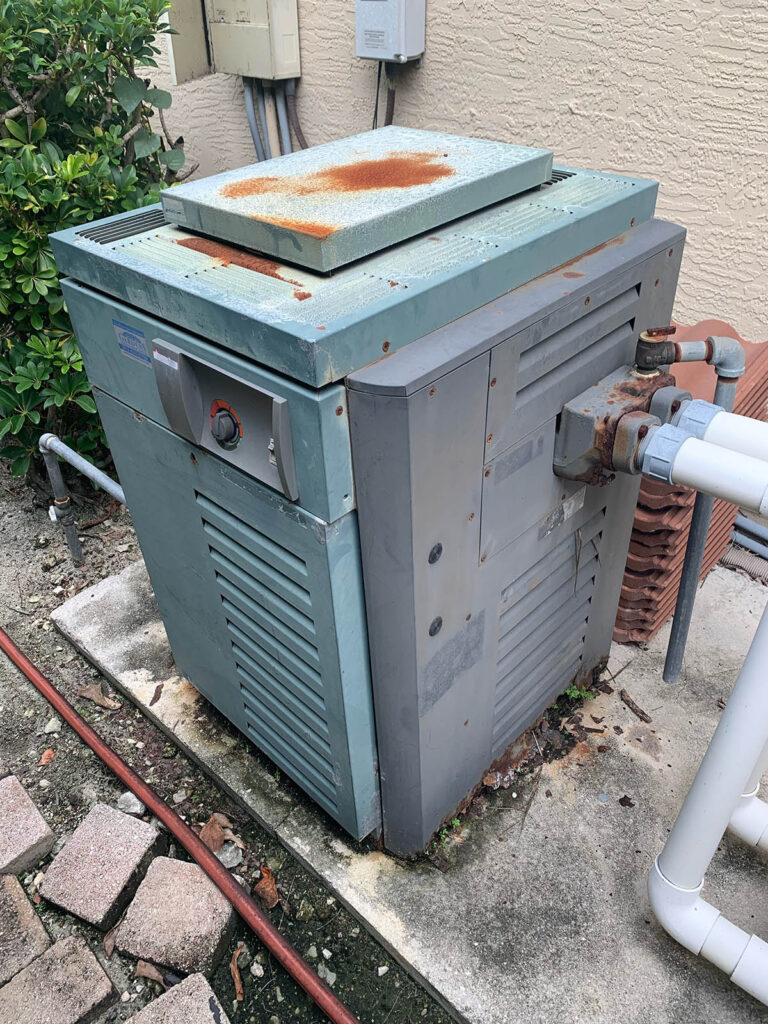
If your heater is running but not reaching the set temperature, the issue may involve flow restrictions, scale buildup, sensor malfunction, or internal component wear.
In that case, professional diagnostics may be necessary. Learn more about heater diagnostics and mechanical troubleshooting on our Pool Repair page.
Photo Credit: Hero Image by Eric Prouzet
- Phone: (561) 566-9344
- Email: [email protected]
-
Address: 1335 Old Okeechobee Rd. #450
West Palm Beach, FL 33401 - Mon – Fri: 8:00 AM – 6:00 PM
- Sat & Sun: 9:30 AM – 4:00 PM